
Sometimes, the biggest obstacle to positive change is not a lack of ideas, but the way we respond when a new idea comes to us.

Every meaningful change begins somewhere. Sometimes it begins with a big vision, but more often it starts with something very ordinary: a person noticing a problem, thinking of a different possibility and deciding to do something about it. A teacher tries a new approach. A young person starts an initiative. A company finds a better way to solve an old problem. A community comes together to address something everyone had simply learned to live with.
But between an idea and its reality, there is often something we don’t talk about enough: people’s response to the idea.
A new idea rarely enters an empty space. It enters an existing system, a routine, a workplace, a school, a family or a community where things are already being done in a certain way. And that is where some of the biggest barriers to change can quietly appear—not always because someone wants to stop change, but because new things often ask us to look beyond what we already know.
Every New Idea Enters an Old Routine
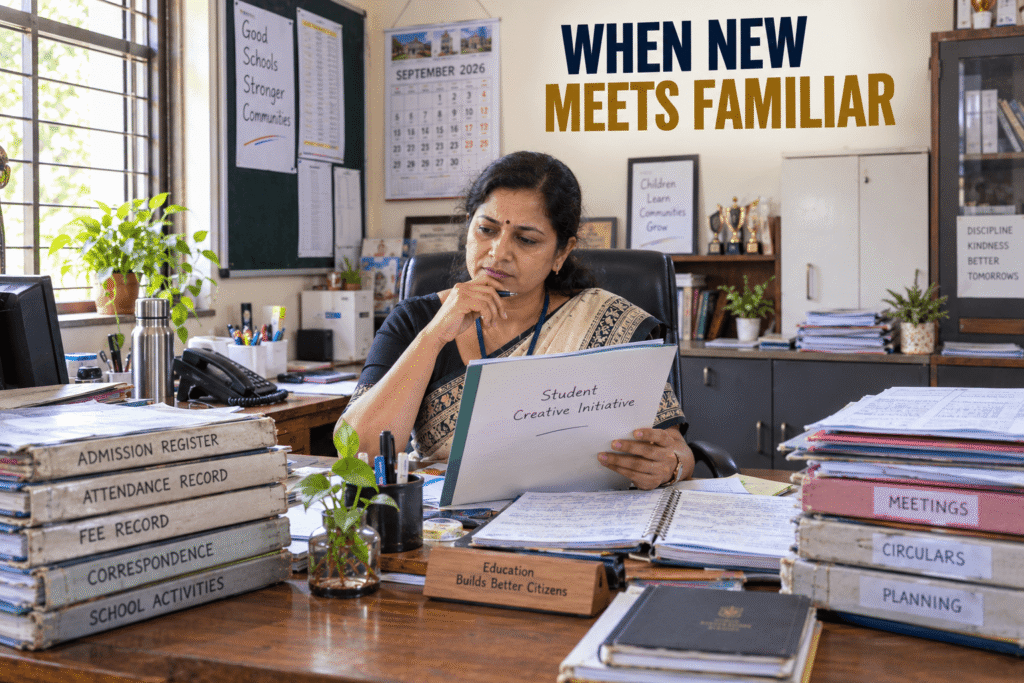
We naturally feel more comfortable with what is familiar. We know how it works, what it requires and what to expect from it. A new idea brings questions. Will it work? Who will manage it? How much time will it take? What if something goes wrong?
Those are sensible questions. In fact, they should be asked.
The problem begins when the questions are never really asked because the decision has already been made.
“We don’t do this.”
“We have never tried this before.”
“It will be difficult.”
“Let’s see later.”
Sometimes these are genuine reasons. But sometimes they are simply different ways of saying, “This is not how we are used to doing things.”
That difference may seem small, but it can have a big impact. A good idea can survive criticism. It can improve through questions. It can change direction when necessary. What it cannot survive very easily is being dismissed before anyone takes the time to understand it.
The Problem Is Not Always the Idea
There is an interesting habit in the way we respond to new things. When something does not fit comfortably into our routine, we often examine the idea before examining our own response to it.

We may call an initiative impractical when the real issue is that it requires extra effort. We may call something unnecessary because it changes a process we are comfortable with. We may assume something will not work because we have never seen it work before.
This is where barriers to change become difficult to recognise. They do not always look like opposition. Sometimes they look like delay. Sometimes they look like silence. Sometimes they look like a conversation that never happens.
And often, the person creating the barrier may not even realise they are creating one.
A Small Experience That Raised a Bigger Question
While working on a student initiative, we experienced situations that made this thought much more real.
There were students who wanted to participate and parents who were interested. The intention was simple: create an opportunity for children to express themselves, participate in something beyond their regular routine and experience something new.
Yet reaching some decision-makers was not always easy. Some messages received no response. Some conversations never happened. Some opportunities ended before there was a real discussion about them.
This is not a complaint about anyone. Schools, organisations and individuals have their own responsibilities, schedules, policies and limitations. Not every initiative is suitable for every place, and saying no can absolutely be the right decision.
But the experience left behind a question that stayed with us:
What happens when a decision comes before an understanding?
That question is much bigger than one initiative. It applies to businesses, communities, educational institutions, workplaces and even our personal lives.
Why Do We Resist What We Don’t Know?
Perhaps one reason is simple: unfamiliar things make us uncertain.
When something is familiar, we know where we stand. When something is new, we have to think again. We may need to ask questions, change a routine, give our time or take responsibility for something we have not handled before.
It is easier to stay with what we already know.
This does not make anyone a bad person. It makes us human.
But being human also means that we can become aware of our habits and choose differently.
The real question is not whether we should accept every new idea. We shouldn’t. The real question is whether we are giving ourselves enough time to understand an idea before deciding what it deserves.
That is one of the most important differences between resisting change and thoughtfully evaluating it.
Sometimes Protection Becomes a Barrier
There is another side to this that deserves attention.
Many people who become barriers to change are not trying to harm anyone. In their own minds, they may simply be protecting something.
A school may be protecting its schedule. A manager may be protecting a team’s workload. A parent may be protecting a child from disappointment. An organisation may be protecting a process that has worked for years. Sometimes that protection is necessary. But sometimes, while protecting what already exists, we unintentionally prevent something better from entering.
That is why this subject should not become a story about blaming “those people.” It is a story about all of us.
Because every one of us has been on both sides of a closed door at some point in life.
The Cost of Closing the Door Too Early
We usually notice successful ideas. We see the initiative that grew, the person who succeeded and the change that eventually became visible.
What we rarely see are the ideas that disappeared quietly.
Maybe a student stopped trying after being told their idea was not useful. Maybe someone with a genuine solution never got the opportunity to present it. Maybe a small community initiative never reached the people who could have benefited from it.
We cannot know how many possibilities disappear this way.
That is what makes barriers to change so difficult to measure. The loss is often invisible. There is no report that tells us what could have happened if someone had simply listened a little longer.
An opportunity that never begins leaves no evidence of what it might have become.
We Don’t Have to Say Yes. We Just Have to Listen.
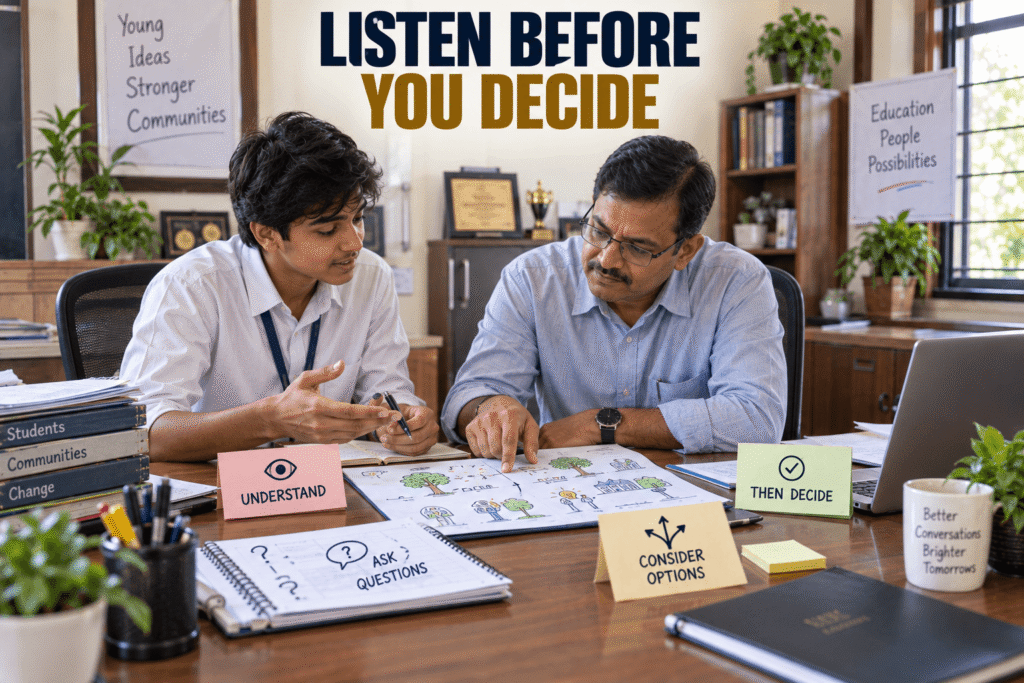
Perhaps the answer is not to become more agreeable. It is to become more thoughtful.
When a new idea comes to us, we can ask a few simple questions: What is the person actually trying to do? Who could benefit from it? Is there a genuine problem with the idea, or does it simply require something different from us? Could it work in another form?
After that, we may still say no.
But it becomes an informed no.
There is a quiet dignity in being able to say, “I understand what you are trying to do, but it is not right for us.”
That is very different from never giving the idea a chance to be understood.
What If We Looked at the Barrier Differently?
We often imagine barriers to change as large things: lack of money, lack of resources, difficult systems, rules or circumstances.
Sometimes they are.
But sometimes the barrier is much smaller.
A closed mind. A delayed response. A conversation that never happened. A person who decided something would not work without asking what it could become.
And perhaps the most uncomfortable possibility is that we may sometimes be that person.
We don’t need to support every idea. We don’t need to open every door. We don’t need to change everything around us.
But we can choose not to close a door simply because what is standing outside it is unfamiliar.
Because every person who brings a new idea is bringing more than an idea. They are bringing their time, their effort, their hope and, sometimes, the courage to try something that has never been tried before.
The least we can offer them is a fair hearing.
Before We Become the Barrier
Change does not always begin with a big decision. Sometimes, it begins with something much smaller — someone choosing to listen, someone being willing to understand, someone deciding not to close a door too quickly.
We may not be able to support every idea. We may not be able to accept every opportunity. And we do not have to.
But perhaps we can leave a little space for possibility.
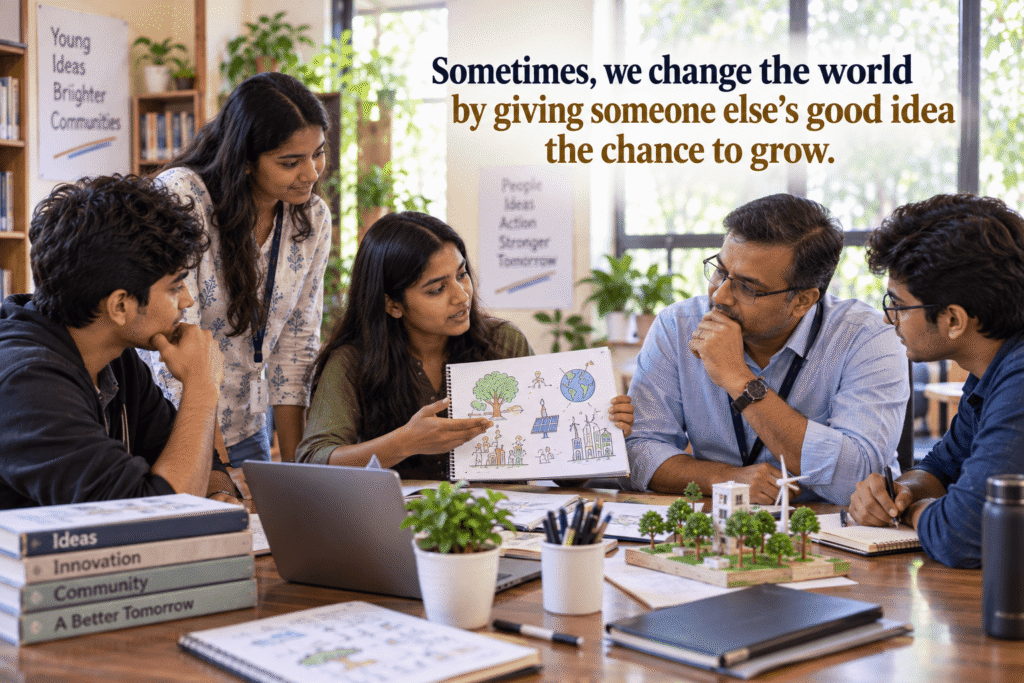
Because behind every new idea, there is a person who believed it was worth trying. There is effort that we may never see, courage that we may never know about, and sometimes a hope that is much more fragile than it appears.
So before we become another one of the barriers to change, perhaps we should pause and ask ourselves:
Am I protecting something that truly needs protection, or am I simply protecting what I am comfortable with?
Maybe the idea will fail.
Maybe it will change.
Maybe it will become something nobody expected.
But if we never allow it to begin, we will never know.
And perhaps, years from now, we won’t remember the small decision we made that day.
But someone else might.
They may remember that when they brought an idea to us, we listened.
When they asked for a chance, we gave them one.
When the easier thing was to close the door, we left it open for a little longer.
Because sometimes, we don’t change the world by creating something ourselves.
Sometimes, we change it by making sure someone else’s good idea gets the chance to grow.
And sometimes, the smallest act of kindness is simply this — not standing in the way of something that might become beautiful.
Connect with YuvaRise on social media.